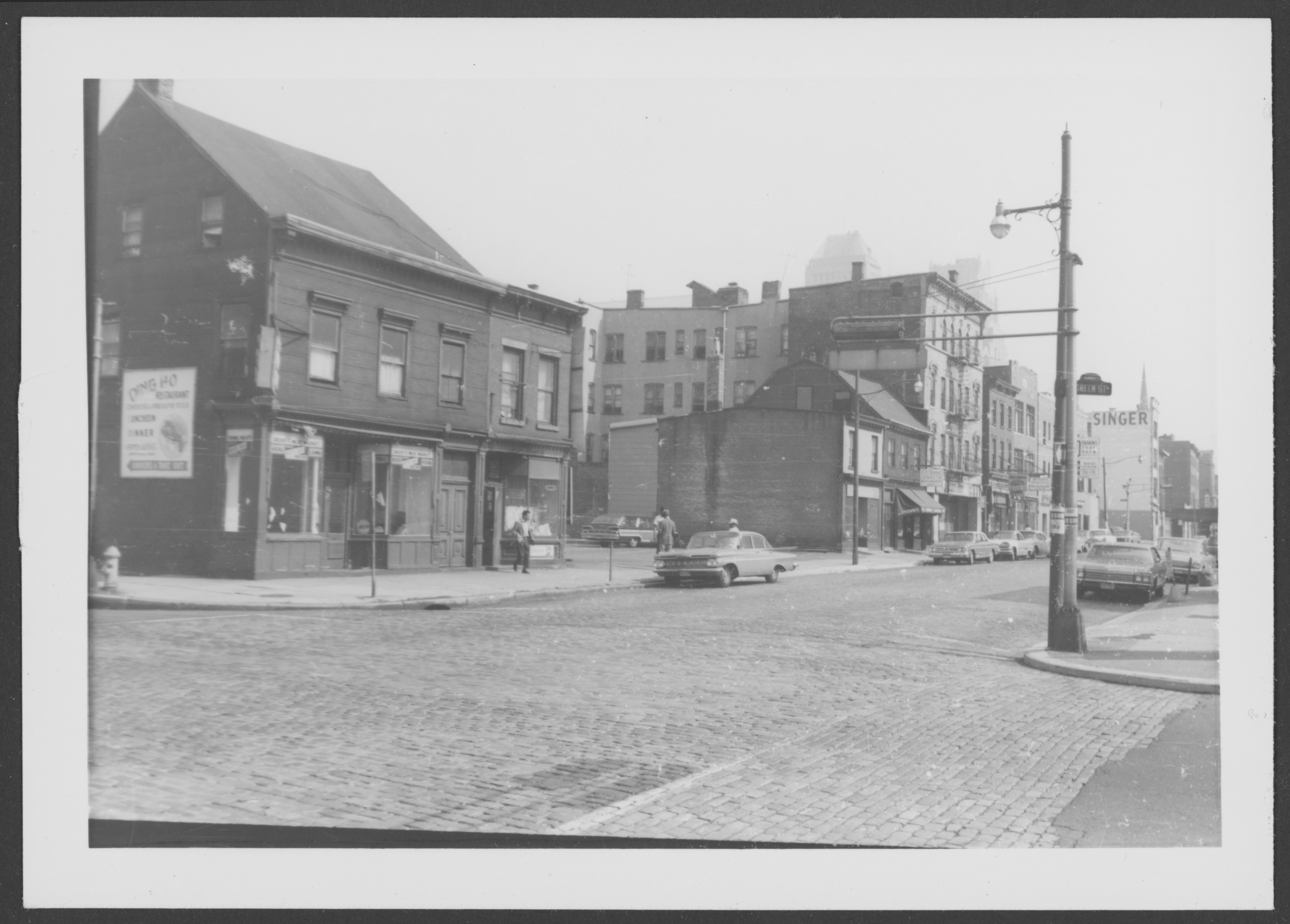
N side Avon looking NE from SW corner Bergen on June 4, 1961

John-Paul DeRosa​ writes:
“My great-aunt Eleanor Britton​ lived at 204 Avon Avenue in Newark, worked at 192 Market next to Four Corners, studied drawing and costume design at the Fawcett School evenings on Academy Street, and attended the Clinton Avenue Presbyterian Church.

“​Her diary is all about her social life and it is chiefly concerned with fashion, boys, dance, etc. She mentions dozens of businesses and I have tracked down most of them, along with nearly half of the 180 people mentioned by name. Later, from 1931-1938 she again wrote diaries in Newark and mentions some 3,000 or more people in her social life during that time.​”

La Esquinita Bodega and Grocery on May 28, 1962

S side Orange St looking SW from opposite Eagle St:

Anne Mabry writes:
“The ubiquity of the corner bodegas in Newark cannot be underestimated just because all are gone. There were family-owned businesses at the corner of Burnet and Orange, the corner of University and Orange, the corner of James and High Street, and just about everywhere else. I remember well the one at the corner James and High Street that was named after Saint Michael’s Hospital. It had everything: from bananas to fresh Portuguese rolls to cat food. Even Halloween candy when I took my two young children there for trick or treat. My neighbor Bill Chappel swore by their hot coffee.

“It now sits with a torn awning, broken windows, and graffiti on the iron-gated door. There is a verbal promise from NJIT to not tear it down. And so the Saint Michael’s bodega sits abandoned… waiting for a new lease on life.”

S side Orange St looking SE from opposite Essex St on May 28, 1962

Greg Calloway (pseudonym) writes:
“I started working as a public employee at the nearby building in 1970. This building on the corner was a flophouse and rooming house with shady characters sitting out front. I remember walking past, seeing empty liquor bottles in the windows, and then thinking to myself: ‘This is not a reputable neighborhood institution.’ Around the corner there used to be an even seedier dive bar named Shorty’s I believe.”

Theresa Randolph’s childhood home at 167 Pennsylvania Avenue was demolished to create a parking lot for garbage trucks.

East side Pennsylvania looking northeast from southwest corner of Vanderpool on May 18, 1961:

Theresa Randolph writes:

In 1934, my parents paid $1,500* to buy that house at 167A Pennsylvania Avenue in the Lincoln Park neighborhood. I was born five years later in 1939. We were the first black family in the neighborhood. Neighbors on one side of us were Italian. Neighbors on the other side were Polish and Irish. Most people in the neighborhood were white immigrants from Europe.

Now the tavern on the corner at 171 Pennsylvania Avenue was named Stern’s Bar and & Grill. It was owned by a Jewish man. My dad and other blacks soon learned that this store owner refused to sell to black customers. You could enter and sit down, but he would just refused to serve you. We learned to avoid Stern’s tavern and to bring our business elsewhere. That wasn’t much of a problem back in those days because we had a choice of many other taverns and corner stores in the neighborhood. We could walk everywhere, and all the businesses that we needed were within walking distance of our home.

*$1,500 in 1939 is equal to $15,000 adjusted for inflation in 2025.

167A Pennsylvania Avenue:

Stern’s Tavern is now closed. Theresa Randolph’s house was demolished and transformed into what is now a parking lot for City of Newark garbage trucks.

E side Hillside looking NE from Watson on April 21, 1962

Carolyn Peggy Smith writes:
“I was renting an apartment at 29 Watson Avenue in fall 1965. I was living here with my dad Samuel Q Cody, my mother Shirley Cody, and my one-year-old son Anthony Smith. I don’t remember much about the other businesses on Watson Avenue. But I do remember that down the street at the bottom of the hill was White Castle, where we went for hamburgers and fast food on special days. That was a real treat!

“It was a racially integrated neighborhood. On the ground floor was C Nesmith’s grocery story, where I used to buy candy, sodas, and other daily goods for our home. All told, there were probably a dozen family-owned grocery stores and hundreds of small businesses in the area. And now there are almost none.

“I went to school just up the street at the Peshine Avenue Elementary School. Those were the days when we did not have a car. We had to walk everywhere. It was more work to get around. But it was easier to stay physically in shape when almost everything we needed to buy was nearby.

“After having my son Anthony, the highway came through our neighborhood and took us from our home.”

Note: Interstate 78 was built in the 1960s and displaced about 8,000 Newark residents in the Weequahic neighborhood, as well as at least 500 family-owned businesses. A few of these businesses were on Watson Avenue, which used to be a commercial street before the highway came through. The winter 1965 city directory records the names of a few of these Jewish-owned and black-owned family businesses, just months before they were demolished:
– McCall’s Hair Fashions
– Fisher Bros Cleaners
– Hillco Frozen Meats
– Les Femmes Beauty Shop
– Norman’s Beauty Shop
– C Fong Laundry
– Leola’s Variety Shop / Neighborhood Barber Shop
– Norman’s Prescription Pharmacy
– Holy Trinity Pentecostal Church of the Living God.

Looking SE at S side 12th Ave from Wallace St, #2-14

Haarith Alston-Taalib writes:

“Back in the 60s, at the time of the riots, my family lived at the corner of Wallace Street and 12th Ave. There’s a little triangular shaped park that’s still there today. We lived above John M. Riccio’s grocery store. The little park sat in the center of West Market, 12th Ave. and Wallace Street. When I visit Newark, I drive past there sometimes; it brings back Wallace Street memories. Thanks for providing these photos of Newark. It warms the heart to see those old streets, stores, buildings, parks, uses, trucks, cars, etc.

“I lived at the intersection of Wallace Street and 12th Ave. There was a hospital across the street from where I lived and a triangular shaped park across the street from me (the park is still there today). I lived in the block between 12th and 13th avenues; 32 Wallace street was right at the corner. I still have a photo of me as a kid standing at this street corner posing for a photo on Easter. The fire hydrant is still there at the corner today; there’s a new building there now where my house was. I lived at 32 Wallace street.”

Riccio’s bodega advertised the following products and prices in April 1967:
– Spaghetti sauce for 19¢
– Liquid starch for 35¢
– Maine sardines for $2.25
– Fancy peaches for 29¢
– Pineapple juice for 25¢
– Dog food for $3.25
– Print lard for $2.35
– Canned sodas for $1.99

A kid returns home after shopping at Riccio’s in April 1967:

The identical street scene and view in December 2024:

All that survives today from history is this fire hydrant and the broken carcass of a rental scooter:

Haarith Alston-Taalib standing in front of Riccio’s on or around 1967.
The same fire hydrant is in background: