Map of All Demolished Buildings


‣ Click icons for thumbnail images.
‣ Click thumbnails for photo comparison with contemporary Google street view.
‣ Thumbnails launch photo comparison on new page.

Travelers' Map is loading...
If you see this after your page is loaded completely, leafletJS files are missing.

Map color key accurate as of summer 2026.
Map will be updated as the city continues changing.

W side Johnson Ave looking SW from #284 on December 9, 1961

Jane Davis​ writes:
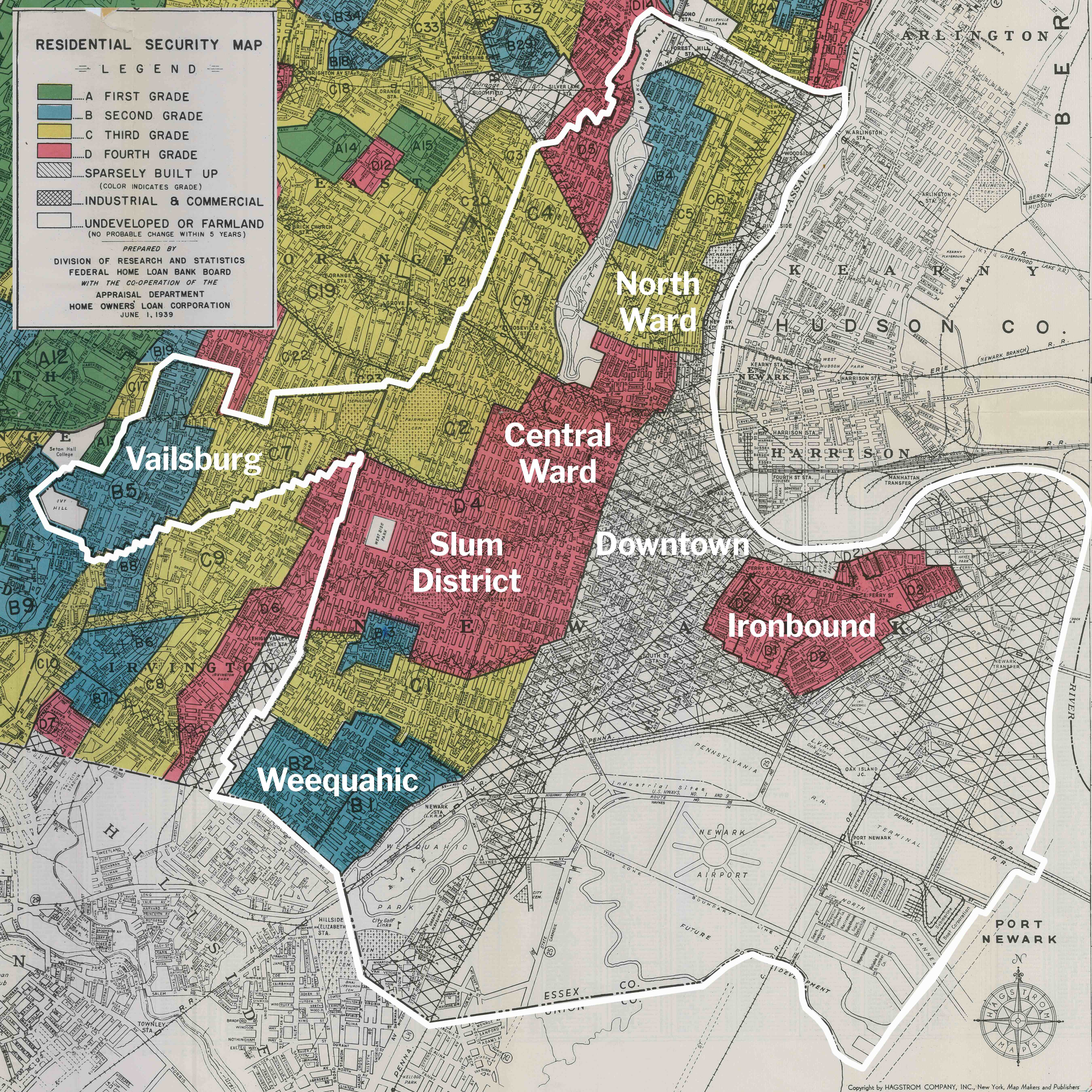
​”The beautiful ​Weequahic section I lived in was murdered by politicians and the real estate industry as their answer to the Black migration. (My parents came to Newark from Georgia in the late 1940s.) My family’s home — 141 Watson Ave. — was the last house torn down on that street to make way for the highway. Such a travesty. ​[….] It’s amazing how the Newark that was — and thus how/why it was dismantled — nowadays is unknown to… most people. And Blacks often get blamed for driving the city into the ground–for the historically ignorant, the myth/slander/libel of ‘there goes the neighborhood’ really took hold. In any case, Newark still means so much to me and is most certainly my ‘home.’​

​”In any case, I just wanted to say that the part of the website that has ‘before and after’ photos showing what had been in contrast to the emptiness of the highway is SO amazingly meaningful and essential — at last, I can SEE the houses, stores, etc., that made up my home but that have been erased for decades now. So, though there is much more to say about Newark, I just want to say a huge thank you from the bottom of my heart​.”

E side Bergen looking NE from SW corner Jeffery Place on December 3, 1961

Charmelle Vickers writes:
“My family lived at 34 Conklin Avenue in Weequahic. In Newark. Mary Alice and Clifford Hubbard lost their home when city planners forced through Interstate 78. That highway displaced thousands of people. After losing their home on Conklin Avenue, my family moved south to a part of Weequahic that was not yet destroyed. Their old wooden home was beautiful. I remember it. Thank you.”

Note: No known photo survives of 34 Conklin Avenue. The above image shows a similar-looking home on the next street over.

E side Searing St looking N from NW corner Summit Place on July 24, 1960

Anthony DiPalma​ writes:
​”I was actually born and lived my first years on the West Side of that same street: at 23 Searing Street. It is unfortunately not in the photo – except for a small portion of the garage.​ I would give anything to see a picture of that building or of that side of the street before it was torn down​.”

N side Warren St looking W from SE corner Summit St on July 24, 1960

T​om C writes:
​”As an engineering student at NJIT from 1981 to ​’86 I was able to still see some of the beautiful old Newark intact. My parents ​– who were both natives from the 1920s to late ​’50s ​–​ spoke sadly about the aftermath of the riots and downfall of the huge hi​-rise low​-income ​’housing projects​.’

“Thanks for bringing back some good memories – Newark Museum and the Ballantine House are true gems. Behind NJIT there was a restaurant called the Italian Kitchen. ​The building dated to the late 1880s​, and it was run by an elderly couple who had been there since the ​1950s. No menu, just what they wanted to make. Torn down in 1986​.”

Polhemus House, #69 Washington Street

The Polhemus House on July 21, 1960:

Anne Mabry writes:
“I remember the Polhemus House as a beautiful mansion owned by the Newark Museum that they allowed to run down, simply because they didn’t have the money or the imagination to use it. One day in the early 1990s, I passed by and discovered it had as its ‘owner’ a little black cat that liked to hang out on the stoop.

“The Polhemus House was demolished in 2011 after the Newark Museum determined it was an imminent hazard. A familiar scenario to preservationists, which goes by the term ‘demolition by neglect.’ The site was transformed into a park reflecting the house’s footprint, which itself succumbed to further demolition with the Newark Museum’s ambitious expansion and construction of apartments.

“Today, not a trace of the Polhemus House remains.”

Wiss Building, W side Littleton between West Market & 11th Ave on July 2, 1969

D​amon Pressman writes:
“I’ve been doing research on Newark, specifically from about 1909-1923. My great-great grandfather apparently had a luggage factory at the corner of Seventh and Summer Streets. He was Max Naidis, and the M. Naidis Trunk & Bag company operated there during this time. It’s an empty lot now​.​”

S side Mercer St looking W from Mercer Court on July 2, 1960

​Allan Lacki writes:
“My dad grew up in Newark, NJ during the 1920s and 1930s. When I was a kid in the ’60s, he used to drive us through the old neighborhoods where he used to live.

“They were used-up by then. Unlike the brownstone sections of Manhattan and Brooklyn, the houses were made of wood and could not be restored because they had been neglected for so many years. And they were mixed in with gritty factories, garages, and other industrial establishments that detracted from whatever visual appeal the streets may have had. After the 1967 riots, the flight to the suburbs accelerated, leaving the city destitute for so many years.”

Baxter Terrace, S side Orange St looking SE from NE corner Nesbitt on July 2, 1961

Phil Yourish writes:
“After my dad returned from fighting in Europe during World War II, we moved with my mom into Baxter Terrace public housing. Public Housing was still racially segregated. I remember growing up in public housing. On snow days, I remember riding my sled on the sidewalk down the slope of James Street to Washington Park. On the way, we passed the houses and corner store where my parents shopped for groceries. All of this is now demolished.”

S side Orange St looking SW from NW corner North 13th St on July 2, 1961

J Muse (Anne’s Grandbaby) writes:
“Absolutely fabulous work. I can only imagine the time and dedication and research it took to make this site a reality. I wasn’t even born at the time these majestic buildings and stores were intact. Even still, it felt like a trip down memory lane. Thank you for your time and devoted effort. This should be done in all urban cities across the nation!!!”

S side Baldwin looking W from NE corner West St on June 29, 1960

Anthony Vanacore writes:
“My girlfriend’s great great grandfather Edward F Ganning moved to 100 West Street with his family from the 1890s to 1920s when he died. He raised his youngest son there, and his other kids also resided there in their young adulthood. This is the first photo I’ve seen of the area as it is now redeveloped.”

E side Newton looking NE from SW corner 12th Ave on June 18, 1961

Haarith Alston-Taalib writes:
“My twin cousin GiGi lived on the 2nd floor on 12th Ave. and I lived on the 2nd floor on the corner of Wallace Street; we would stand in our front windows and wave to one another from a distance. She was crying on the phone when she saw this photo. She’s going to cry again when she sees these photos. We played and spent a lot of time together; we got separated after the Newark riots in 1967, and I didn’t see her again until 2024. I’m going to show these to her today, thank you. This part of our lives was lost after the riots; you are helping us remember.”

Hundreds of graves at Old First Cemetery dating to the 17th century were desecrated for what is now Newark’s hockey arena.

Map of Downtown Newark in 1873 vs. 2016

January 1959
Old First Cemetery looking NW from far rear

July 1961
Park lot graveyard Old First Ch. looking NW from Central Railroad Depot

March 1962
Park lot rear Old First church, formerly graveyard

The same location today
The cemetery is now beneath the playing field of the Hockey Arena

The same location today

The same location today
A change in urban form and urban scale

Old First Cemetery looking SW from Central RR Depot

Old First Cemetery showing a mound at SW corner

Old First Cemetery showing steps to be excavated, a mound at SW corner

Old First Cemetery looking NW from Central RR Depot

#50 Burnet on June 10, 1960

James Hollaway writes:
“I was born on this street and lived here all my life. I just turned 80 last year. This was the Piacek house, belonging to a white family from Poland. I used to play with their son. Their kid grew up and left home. One day, the house went silent. We learned weeks later that there had been a murder in that house.”

#93-81 Clay St on June 9, 1962

Dee Kirk writes:
“I grew up one block from here on Stone Street in the 1940s, in a building that looked just like the ones here. My Italian mother worked on a sewing machine in a sweatshop. We lived in a long and narrow tenement. The innermost rooms had no natural light. But there were so many other children like me on the street. On Sundays, the Catholic nuns from St. Lucy’s would walk down the street ringing bells and calling all of us children to Sunday school. In the 1950s, all of Little Italy and my childhood home in Newark was demolished.”

N side Avon looking NE from SW corner Bergen on June 4, 1961

John-Paul DeRosa​ writes:
“My great-aunt Eleanor Britton​ lived at 204 Avon Avenue in Newark, worked at 192 Market next to Four Corners, studied drawing and costume design at the Fawcett School evenings on Academy Street, and attended the Clinton Avenue Presbyterian Church.

“​Her diary is all about her social life and it is chiefly concerned with fashion, boys, dance, etc. She mentions dozens of businesses and I have tracked down most of them, along with nearly half of the 180 people mentioned by name. Later, from 1931-1938 she again wrote diaries in Newark and mentions some 3,000 or more people in her social life during that time.​”

Looking SW on 12th Ave & Wallace St, Newark Memorial Hospital, on June 1, 1967

Haarith Alston-Taalib writes:
“Yes, my twin cousin lived on 12th Ave. between Wallace and Newton Streets; she lived across from the hospital on the 12th Ave. side. I’m going to find out if she has any pictures of 12th Ave. and the hospital. Both of us played in that triangular shape park there on 12th Ave. at Wallace Street. Whenever I’m in Newark and I ride by that area, I can remember the building in the lower photo, all that greenery and the neon sign there at the corner; that was the view out our kitchen window. Thank you, this was a dream come true, I never thought I’d see images like these again from my early childhood.”

Shown here is the view of the neon sign and fire hydrant outside of Haarith Alston-Taalib’s kitchen window. The neon sign says “Newark Gardens Convalescent Home”:

S side Waverly Ave looking W from NE corner Monmouth on May 30, 1960

Fredrica Bey writes:
“My Aunt Ampa grew up here in an apartment. It had no hot water and no refrigerator. One day, she learned that she was eligible for Newark’s first urban renewal public housing project that had just opened. The new apartment was small. But she was very proud of it and proud to live in public housing because the space was hers. One day, First Lady Eleanor Roosevelt came to give her an award for having the ‘best kept’ apartment in the complex. I still have the photo of Aunt Ampa with Lady Roosevelt.”

Aunt Ampa with Lady Roosevelt:

La Esquinita Bodega and Grocery on May 28, 1962

S side Orange St looking SW from opposite Eagle St:

Anne Mabry writes:
“The ubiquity of the corner bodegas in Newark cannot be underestimated just because all are gone. There were family-owned businesses at the corner of Burnet and Orange, the corner of University and Orange, the corner of James and High Street, and just about everywhere else. I remember well the one at the corner James and High Street that was named after Saint Michael’s Hospital. It had everything: from bananas to fresh Portuguese rolls to cat food. Even Halloween candy when I took my two young children there for trick or treat. My neighbor Bill Chappel swore by their hot coffee.

“It now sits with a torn awning, broken windows, and graffiti on the iron-gated door. There is a verbal promise from NJIT to not tear it down. And so the Saint Michael’s bodega sits abandoned… waiting for a new lease on life.”

S side Orange St looking SE from opposite Essex St on May 28, 1962

Greg Calloway (pseudonym) writes:
“I started working as a public employee at the nearby building in 1970. This building on the corner was a flophouse and rooming house with shady characters sitting out front. I remember walking past, seeing empty liquor bottles in the windows, and then thinking to myself: ‘This is not a reputable neighborhood institution.’ Around the corner there used to be an even seedier dive bar named Shorty’s I believe.”

Theresa Randolph’s childhood home at 167 Pennsylvania Avenue was demolished to create a parking lot for garbage trucks.

East side Pennsylvania looking northeast from southwest corner of Vanderpool on May 18, 1961:

Theresa Randolph writes:

In 1934, my parents paid $1,500* to buy that house at 167A Pennsylvania Avenue in the Lincoln Park neighborhood. I was born five years later in 1939. We were the first black family in the neighborhood. Neighbors on one side of us were Italian. Neighbors on the other side were Polish and Irish. Most people in the neighborhood were white immigrants from Europe.

Now the tavern on the corner at 171 Pennsylvania Avenue was named Stern’s Bar and & Grill. It was owned by a Jewish man. My dad and other blacks soon learned that this store owner refused to sell to black customers. You could enter and sit down, but he would just refused to serve you. We learned to avoid Stern’s tavern and to bring our business elsewhere. That wasn’t much of a problem back in those days because we had a choice of many other taverns and corner stores in the neighborhood. We could walk everywhere, and all the businesses that we needed were within walking distance of our home.

*$1,500 in 1939 is equal to $15,000 adjusted for inflation in 2025.

167A Pennsylvania Avenue:

Stern’s Tavern is now closed. Theresa Randolph’s house was demolished and transformed into what is now a parking lot for City of Newark garbage trucks.

E side High looking SE from NW corner Bank, toward West Market, on May 17, 1960

Ron Roi writes:
“I would walk to school in the early 50’s. From High Street, Bank Street, and right to Courthouse Place. I knew several people in these brownstone homes. These were beautiful buildings. I’m still alive at age 77. Most of my dear friends are departed. But my memories of old Newark live on with me.”

Roseville Masonic Temple, #65-63 Roseville Ave, on April 26, 1962

Dan O’Flaherty writes:
“Yes, the Masonic Temple was across the street from my childhood home on the 3rd floor of 62 Roseville Avenue. It was beautiful (and huge, like everything else on Roseville Avenue to me). I remember looking out the 3rd floor window at the blue globes with the stars on them. I never saw anything going on there, though.”

#56 & 60 Roseville Ave on April 22, 1962

Dan O’Flaherty writes:
“From the left, Richie and Ronnie Giuliano lived on the second floor (I think) of the 3-decker. They were older than us but we played with them. They were cousins of the two Anthony Giuliano’s who were city councilmen at large in the 60s and 70s. Patsy Madera, about their age, was on the third floor. Her father Al )Eldo) Madera, was an inspector for the City. My parents knew him and I got to know him in the 80s. The next house, the 2-story, was where the Gibbons brothers practiced dentistry and where we went for dentist visits. You can see a sliver of our house, 62 Roseville on the far right. Pig Tail Alley ran behind all these houses.”

#62-64 Roseville Ave on April 22, 1962

Dan O’Flaherty writes:
“I grew up in this house. Wow. Thank you. It’s so small! Dr Samuel Fortunato owned the building and used the first floor for his practice. Very convenient for me. I don’t remember a sign, but I would imagine he did. This suggests that by 1962 he had stopped practicing there.”

Amiri Baraka’s House at 33# Stirling Street was demolished to build a parking garage. Photographed on April 22, 1962.

The entirety of Stirling Street, along with all its dozens of brownstones, was cleared for the parking garage and parking lot of the Essex County Courts complex. Stirling street today runs through the middle of this super block.

#33 Stirling Street on left, #25-23 on right behind tree

“I came back to Newark the last day of 1965. Home, a few days, then I found a house on Stirling street, just above downtown Newark, where the interior neighborhoods began to unfold. It was an old three story building, now long gone. I moved in and had it painted light green, with details of red and green, like the flag of a Black nationalist movement. It was to be a site for poetry readings, a theater, a place to hold discussions formal and otherwise and a general gathering site . It soon became all those things.”

Read poet and activist’s Amiri Baraka full-length reflection about his life at Spirit House, written in 2013 >

E side Hillside looking NE from #315 on April 21, 1962

​Rochelle Pleasant writes:
“I was so glad I came across your website with pics of areas near my childhood home. I walked Watson Ave, Peshine Ave, and other streets described. I wondered if you have a photo of Conklin Ave. in your photos you took? Conklin Ave was one block from Seymour Ave to Osborne Terrace sandwiched between Yates and Nye Avenues. There was a synagogue on the corner of Conklin Ave and Osborne Terrace.

“A lovely community with a variety of races with children that played with one another. Some of us who lived there still communicate with one another. Sadly, our street was demolished and our family moved in 1968 due to the building of Highway 78. Our families fought for 10 years against the decision. It still pains me to think of having to move and our home no longer in existence, but, the good memories while living there warm my spirit. If you have any pics or know of organization or agency that may have pics, please let me know. Thank you for creating this site so people won’t forget these communities long displaced. This is history that needs to be shared to a larger audience.​”

E side Hillside looking SE from SW corner Hawthorne on April 21, 1962

Veronica Battle writes:
“Thank you for the old pictures from Newark Changing 1950s to today. I grew up in Newark. Mainly in the Clinton Hill & Weequahic Sections. I remember when they were demolishing some parts of these areas. Did you take any photos of the areas of Wainwright, Leslie, Hobson, Dewey, Bragraw, Schley Fabyan and surounding streets. These streets, homes and people were displaced because of I-78. They didn’t completely finish I-78 until the early 1980s.”

W side Hunterdon looking SW from NE corner Lawton on April 21, 1962

Jane Davis writes:
“I must have been age eight or nine. I walked down the stairs of our family home at 161 Watson Avenue late at night. And I remember overhearing my parents arguing in whispered tones talking about what to do. They had just received the government notice, evicting them from their home to build the highway. They argued: ‘Should we sell right away and get away? Or should we stay and fight to get a fair price for the value of our home?’ In the end, we left. I remember their conversation all these decades later.”

E side Hillside looking NE from Watson on April 21, 1962

Carolyn Peggy Smith writes:
“I was renting an apartment at 29 Watson Avenue in fall 1965. I was living here with my dad Samuel Q Cody, my mother Shirley Cody, and my one-year-old son Anthony Smith. I don’t remember much about the other businesses on Watson Avenue. But I do remember that down the street at the bottom of the hill was White Castle, where we went for hamburgers and fast food on special days. That was a real treat!

“It was a racially integrated neighborhood. On the ground floor was C Nesmith’s grocery story, where I used to buy candy, sodas, and other daily goods for our home. All told, there were probably a dozen family-owned grocery stores and hundreds of small businesses in the area. And now there are almost none.

“I went to school just up the street at the Peshine Avenue Elementary School. Those were the days when we did not have a car. We had to walk everywhere. It was more work to get around. But it was easier to stay physically in shape when almost everything we needed to buy was nearby.

“After having my son Anthony, the highway came through our neighborhood and took us from our home.”

Note: Interstate 78 was built in the 1960s and displaced about 8,000 Newark residents in the Weequahic neighborhood, as well as at least 500 family-owned businesses. A few of these businesses were on Watson Avenue, which used to be a commercial street before the highway came through. The winter 1965 city directory records the names of a few of these Jewish-owned and black-owned family businesses, just months before they were demolished:
– McCall’s Hair Fashions
– Fisher Bros Cleaners
– Hillco Frozen Meats
– Les Femmes Beauty Shop
– Norman’s Beauty Shop
– C Fong Laundry
– Leola’s Variety Shop / Neighborhood Barber Shop
– Norman’s Prescription Pharmacy
– Holy Trinity Pentecostal Church of the Living God.