New Jersey College of Medicine and Dentistry


Travelers' Map is loading...
If you see this after your page is loaded completely, leafletJS files are missing.


Map of the neighborhood cleared to build the UMNDJ campus. As the first step in preparation for urban renewal, this survey map was created in 1960 of all property owners, property values, and property lines. Based on this map, the extent of the urban renewal area was determined and communicated to demolition crews.

4,464 people displaced in 1961
representing 925 families
705 of color (76%)
220 White (24%)

Plus an additional 3,163 people after the 1967 rebellion, creating a total of 7,627 people displaced

$26,291,000 in federal funds and
$7,408,000 in city funds
cleared 141.7 acres.

Source

For the university campus that now occupies this site, about 80% of the land is given over to empty space and surface parking.

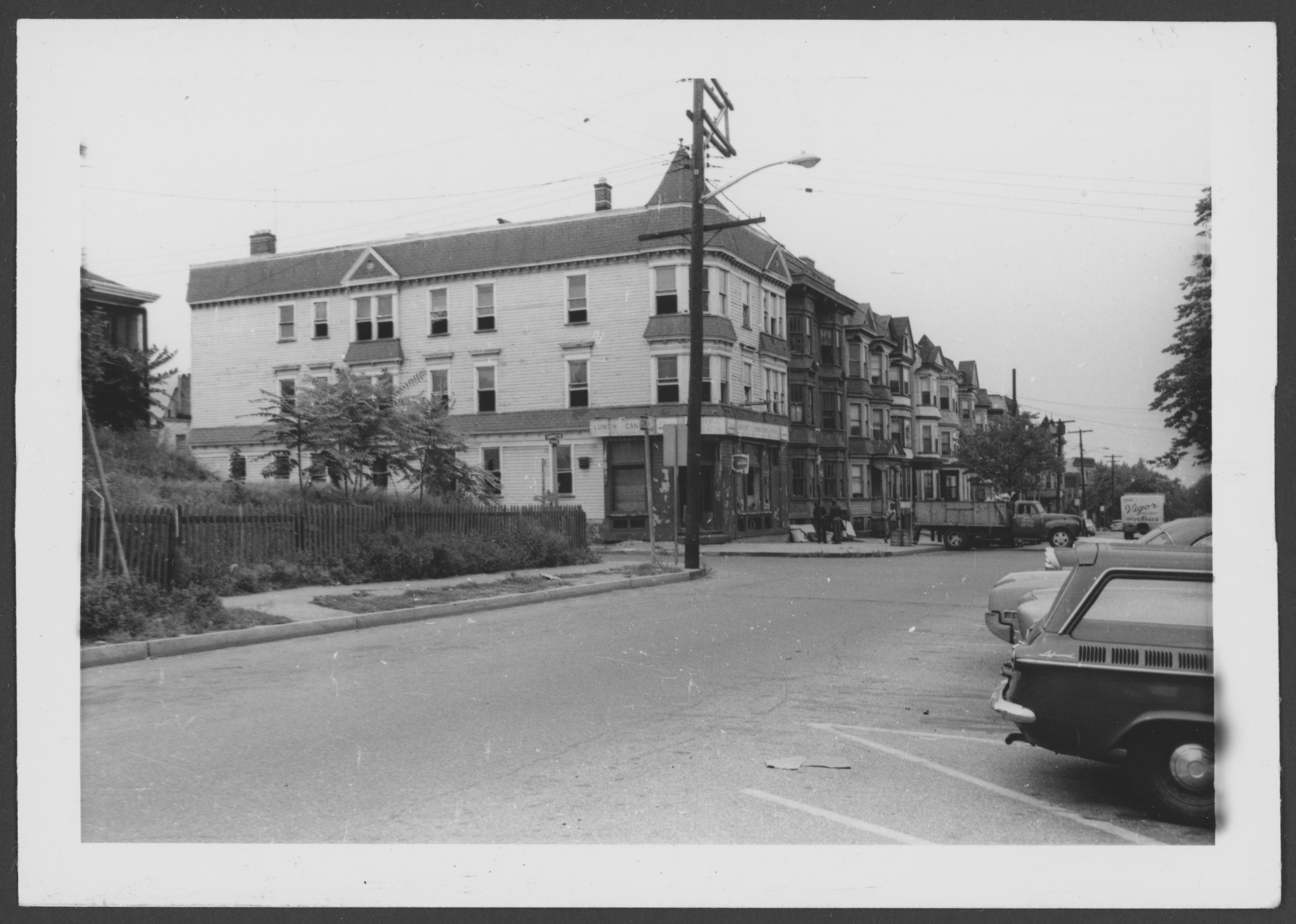
Looking SW on 12th Ave & Wallace St, Newark Memorial Hospital, on June 1, 1967

Haarith Alston-Taalib writes:
“Yes, my twin cousin lived on 12th Ave. between Wallace and Newton Streets; she lived across from the hospital on the 12th Ave. side. I’m going to find out if she has any pictures of 12th Ave. and the hospital. Both of us played in that triangular shape park there on 12th Ave. at Wallace Street. Whenever I’m in Newark and I ride by that area, I can remember the building in the lower photo, all that greenery and the neon sign there at the corner; that was the view out our kitchen window. Thank you, this was a dream come true, I never thought I’d see images like these again from my early childhood.”

Shown here is the view of the neon sign and fire hydrant outside of Haarith Alston-Taalib’s kitchen window. The neon sign says “Newark Gardens Convalescent Home”:

Looking SE at S side 12th Ave from Wallace St, #2-14

Haarith Alston-Taalib writes:

“Back in the 60s, at the time of the riots, my family lived at the corner of Wallace Street and 12th Ave. There’s a little triangular shaped park that’s still there today. We lived above John M. Riccio’s grocery store. The little park sat in the center of West Market, 12th Ave. and Wallace Street. When I visit Newark, I drive past there sometimes; it brings back Wallace Street memories. Thanks for providing these photos of Newark. It warms the heart to see those old streets, stores, buildings, parks, uses, trucks, cars, etc.

“I lived at the intersection of Wallace Street and 12th Ave. There was a hospital across the street from where I lived and a triangular shaped park across the street from me (the park is still there today). I lived in the block between 12th and 13th avenues; 32 Wallace street was right at the corner. I still have a photo of me as a kid standing at this street corner posing for a photo on Easter. The fire hydrant is still there at the corner today; there’s a new building there now where my house was. I lived at 32 Wallace street.”

Riccio’s bodega advertised the following products and prices in April 1967:
– Spaghetti sauce for 19¢
– Liquid starch for 35¢
– Maine sardines for $2.25
– Fancy peaches for 29¢
– Pineapple juice for 25¢
– Dog food for $3.25
– Print lard for $2.35
– Canned sodas for $1.99

A kid returns home after shopping at Riccio’s in April 1967:

The identical street scene and view in December 2024:

All that survives today from history is this fire hydrant and the broken carcass of a rental scooter:

Haarith Alston-Taalib standing in front of Riccio’s on or around 1967.
The same fire hydrant is in background:


Looking NE at E side Bruce St, #66-72 fire escape, on April 1, 1967

Richard Cammarieri writes:
“My family was displaced by the construction for College of Medicine and Dentistry of NJ. Of course the ultimate irony there is that the block I lived on (Bruce St. between Cabinet St. and 12th Ave.) included, on its east side, where I lived (38 Bruce St.) mainly brick-built 2 family houses – not ‘stick built’ like most in that neighborhood. And while families were forced to move, that solid housing remained vacant and deteriorating for at least 10 years without ever being used for the campus.”

Looking NE at E side Wallace St (stable – 34-36-38-set back) on January 1, 1967

Haarith Alston-Taalib writes:

“Yes, at the corner in this photo is where my family lived until June of 1968. We lived in the apartment just above the sign for John M. Riccio’s grocery store; I have a photo of me at that intersection. I also have a photo of my brother Richard and I on Easter standing at that wall next to the door by the car under the billboard. That fence before the garage was our backyard. The garage was where Mr. Riccio’s food supply was stored. Next to our house, on the right, was a house where Nuns lived (it has that gate around it). I’m going to send the photo of me. We moved from there the year after the riots in Newark.”

Haarith Alston-Taalib’s home was the second-floor window on the left. He writes:
“One of those cars near the corner was my dad’s car in 1967-68.”

Photo of the identical location in June 2012, now the campus of UMDNJ:

Looking SE at E side Newton St from 12th Ave (old lab of Newark Memorial Hospital in center) on January 1, 1967

Haarith Alston-Taalib writes:
“I remember that red brick building; it was covered with vines. After the hospital closed, the kids would climb the tall mansion gate on the Newton Street side of the hospital and try to go inside the old buildings; we were never successful.”

Newark Garden’s Convalescent Home, old Clara Maas, SE corner 12th Ave & Newton St on January 1, 1967

The Newark Memorial Hospital in 1916 vs. 2016:

Haarith Alston-Taalib writes:

That one block was my world, my playground; I can visualize just about every house and the neighbors who lived on that block. All of my friends were from the middle to the end of the block. There were no houses across the street from me, just that hospital. I can still see the patients sitting outside in wheelchairs with nursing staff; the trucks making deliveries at the ramp across the street from my house. You don’t know what it did for me to see the photos of where I lived; it brought back a simpler time.

Aerial views from roof of City Hospital show entire neighborhoods cleared for the campus of UMDNJ.

The Belmont neighborhood on June 18, 1961

Looking down southeast from 10th floor Martland

.

And the identical view on September 24, 1967


Looking east from roof City Hospital, leveled area Cabinet Street (left) to 12th Avenue (right), Bergen St (foreground) to Morris Avenue (distance)
.

The Belmont neighborhood on June 18, 1961

Looking down northeast from 10th floor Martland

.

And two identical views on September 24, 1967


Looking northeast from roof City Hospital, leveled area Hunterdon Street (foreground) to Bruce Street (distance, West Market Street (left) to Cabinet Street (right)
.

Looking northeast from roof City Hospital, leveled area Bergen Street (foreground) to Morris Avenue (distance), West Market Street (left) to Cabinet Street (right)
.

Further demolition in 1967 for UMDNJ


Looking northeast from City Hospital
.

Looking down southeast from 10th floor Martland
.

Looking down southeast from 10th floor Martland
.

Looking west from roof City Hospital, Fairmount Avenue (foreground) between 12th Ave (left) and Cabinet (right)
.

Fairmount Ave (foreground), Cabinet Street (lower left), Wiss Factory (center distance), West Market (upper right)