Travelers' Map is loading...
If you see this after your page is loaded completely, leafletJS files are missing.
If you see this after your page is loaded completely, leafletJS files are missing.
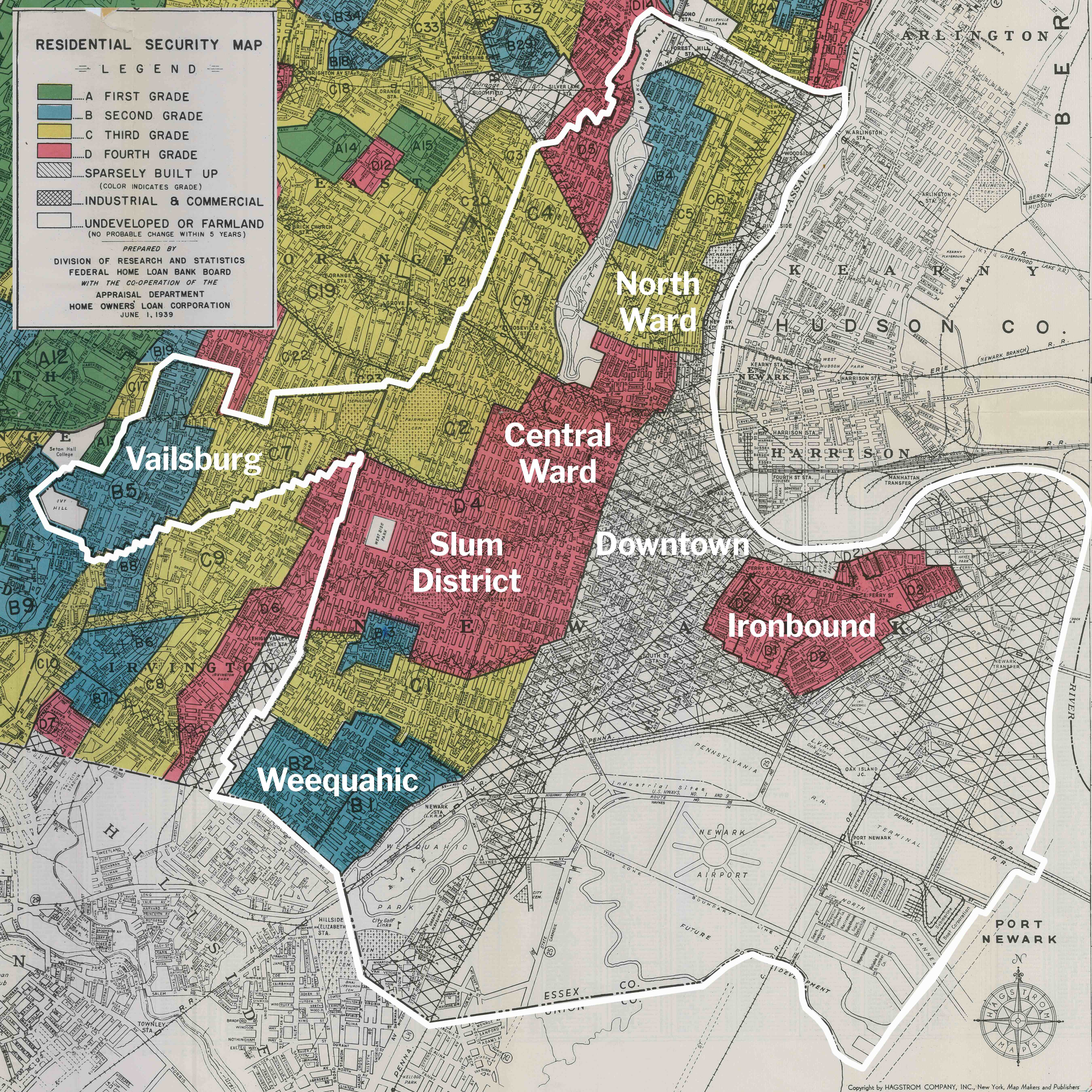
Of the approximately 40,000 people living in Belmont in 1960, over 90% were Black. Most survived on annual incomes less than $3,000 ($30,000 inflation adjusted) per year in comparison to a nationwide average of $5,600 per year ($56,000 inflation adjusted). Over 90% of residents were renters, and few of them were homeowners. Its poverty, its high Black population, and the longer history of denying investment and loans to people living here made this neighborhood particularly vulnerable.
This neighborhood was the most affected and almost entirely erased by urban renewal for public housing projects and the campus of UMDNJ. In the period 1950 to 1990, over 95% of all homes and buildings in Belmont were demolished. In the resulting photo comparisons, almost nothing survives of the communities that once were: dozens of Baptist churches, hundreds of corner stores, and thousands of largely Jewish-owned small businesses.
For most of its history, Newark was a majority-White city, where Blacks represented no more than 10% of the population. Upwards of 30% of Newark’s population was foreign born in the early 20th century, 40% worked in manufacturing, and most were immigrants from Europe. Belmont’s flat land for development, thousands of tenements, and proximity to factories downtown made it ideal for immigrant enclaves of Jews, Italians, Germans, and Poles.
By the 1950s, two major shifts were happening in Belmont, as well as dozens of other old immigrant neighborhoods in northeastern American cities. As Newark immigrants and their children found better paying jobs and integrated into American society, they moved out of crowded Belmont and into more comfortable and mass-produced homes in the low-density suburbs. These new suburban communities were for Whites only, if not by law then by practice. In the 1959 novel Goodbye Columbus, Newark-born author Philip Roth described the journey by car up Springfield Avenue. The drive from working-class Belmont to the upper-class suburb of Short Hills was a journey toward heaven for him:
Once I’d driven out of Newark, past Irvington and the packed-in tangle of railroad crossings, switchmen shacks, lumberyards, Dairy Queens, and used-car lots, the night grew cooler. It was, in fact, as though the hundred and eighty feet that the suburbs rose in altitude above Newark brought one closer to heaven, for the sun itself became bigger, lower, and rounder, and soon I was driving past long lawns which seemed to be twirling water on themselves, and past houses where no one sat on stoops, where lights were on but no windows open, for those inside, refusing to share the very texture of life with those of us outside.
The second major shift was the Great Migration. At least six million Blacks fled from poverty, unemployment, and racial tensions in the south to northern cities they hoped would be better. As internal immigrants within America and as a people at the bottom of the class system, these Blacks settled in the same Newark neighborhoods as earlier generations of White immigrants. Many of Belmont’s Jewish synagogues and Catholic churches were soon sold off and given new life as Black Baptist congregations. But, unlike earlier generations of White immigrants who used Belmont as a stepping-stone to climb the social ladder, Blacks in Newark were locked out of home financing and were only given low-paying manual labor jobs with few chances for promotion.
At the same time, urban renewal projects were eating away at Belmont’s Black homes. This was ground zero for slum clearance and for the violence that resulted. In the name of slum clearance, all of this area was swept clean from map, along with the histories these buildings contained of multi-generational and multi-racial immigrant struggle. Residents had little choice but to move yet again or to stand their ground and resist, as thousands did in the July 1967 rebellion. Newark’s civil unrest started in and was centered on Belmont and its main street of Springfield Avenue.
Samuel Berg’s collection shows Belmont at a historical turning point in the years 1958 to 1962. The Great Migration of Blacks to northern cities was slowing down, while urban renewal projects were picking up pace. These photos document almost every home, building, and business in Belmont near its height as a Black community. Notice in these photos the multi-story tenements and corner stores, for which there is no longer the population or the foot traffic to sustain. The walkable and human-scale fabric of the old city that required generations to organically develop was lost forever, replaced by vacant land, parking lots, strip malls, and endless rows of low-cost prefabricated housing.
In the two maps below, Belmont is the Black neighborhood at center. Compare the extent of Black population growth and neighborhoods in 1970 vs. 2020.
White – Black – Some Other Race

White – Black – Asian – Some Other Race


Allan Lacki writes:
“My dad grew up in Newark, NJ during the 1920s and 1930s. When I was a kid in the ’60s, he used to drive us through the old neighborhoods where he used to live.
“They were used-up by then. Unlike the brownstone sections of Manhattan and Brooklyn, the houses were made of wood and could not be restored because they had been neglected for so many years. And they were mixed in with gritty factories, garages, and other industrial establishments that detracted from whatever visual appeal the streets may have had. After the 1967 riots, the flight to the suburbs accelerated, leaving the city destitute for so many years.”

Anthony Vanacore writes:
“My girlfriend’s great great grandfather Edward F Ganning moved to 100 West Street with his family from the 1890s to 1920s when he died. He raised his youngest son there, and his other kids also resided there in their young adulthood. This is the first photo I’ve seen of the area as it is now redeveloped.”

John-Paul DeRosa writes:
“My great-aunt Eleanor Britton lived at 204 Avon Avenue in Newark, worked at 192 Market next to Four Corners, studied drawing and costume design at the Fawcett School evenings on Academy Street, and attended the Clinton Avenue Presbyterian Church.
“Her diary is all about her social life and it is chiefly concerned with fashion, boys, dance, etc. She mentions dozens of businesses and I have tracked down most of them, along with nearly half of the 180 people mentioned by name. Later, from 1931-1938 she again wrote diaries in Newark and mentions some 3,000 or more people in her social life during that time.”

Fredrica Bey writes:
“My Aunt Ampa grew up here in an apartment. It had no hot water and no refrigerator. One day, she learned that she was eligible for Newark’s first urban renewal public housing project that had just opened. The new apartment was small. But she was very proud of it and proud to live in public housing because the space was hers. One day, First Lady Eleanor Roosevelt came to give her an award for having the ‘best kept’ apartment in the complex. I still have the photo of Aunt Ampa with Lady Roosevelt.”
Aunt Ampa with Lady Roosevelt:

Stephen Pellegrino writes:
“Newark was such a visually interesting city. Most of the old buildings are gone now.”


Fredrica Bey writes:
“I grew up here on Morris Avenue. We lived in a cold water tenement flat, with my mother from the Carolinas, my five siblings, and my adoptive father Mr. Chow from China. That tenement was demolished years ago. I was baptized at Gethsemane and remember the classic cars on our street. Later, I discovered the Nation of Islam and father Elijah Mohammed. I haven’t turned back since.”


Search by street name, not address